Showing posts with label Advanced SEO. Show all posts

Friday, April 24, 2015

Google Analytics - Treemaps report

Explore an interactive view of your Acquisition channels.

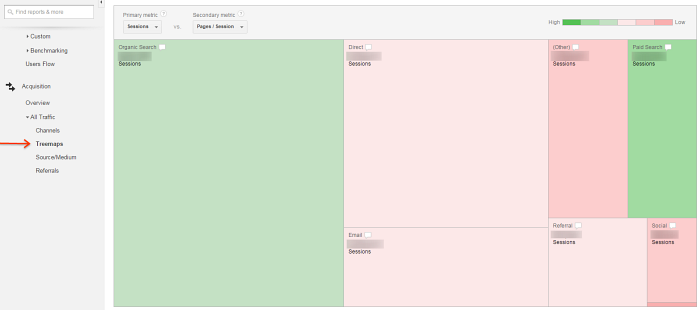
The Treemaps report lets you visually explore trends in your Acquisition channels so you can quickly and intuitively develop hypotheses about your incoming traffic. Treemaps represent data as rectangles. The size and color of each rectangle represent different metrics, so you can combine different aspects of your data into a single visualization. Treemaps are a good hypothesis-generation tool because they can help expose the relative importance of, and the relationship between, different entities.

Use the Treemaps report

Access the report

Type "Treemaps" in the search box above the report navigation, and select the result. You can also browse the report navigation to find it: Acquisition > All Traffic > Treemaps.

Select what data appears in the report

Each rectangle in the report represents a single acquisition channel. Click a rectangle to see a more granular view of each channel displayed in the report. For example, click the Social rectangle and drill down to look at the individual Social Networks where your traffic originated.
Hover over the dialog box icon in each rectangle to get specific data for each metric represented by that rectangle.
After you've clicked a rectangle, a breadcrumb appears above the report to show you where you are in the acquisition channel hierarchy. You can use these links to quickly navigate through the hierarchy. For example, if you've drilled down into the Source level in the report, you can click Referral in the breadcrumb to see that data, instead.

Read the report

All metrics in this report are organized into either a Primary or Secondary group. Use the drop-down menus above the report to select different Primary and Secondary metrics. You can only select one Primary and one Secondary metric at a time.
Primary metrics are volume metrics, like Sessions or New Users, and are represented by rectangle size.
Secondary metrics are relative metrics, like Bounce Rate or Pages/Session, and are represented by color and saturation. Green is positive, and red is negative. The darker the green, the better the Secondary metric, and the darker the red, the worse the Secondary metric.

Example

If you:
  • Are looking at Landing Page within the Email channel
  • Have selected the Primary metric Sessions and the Secondary metric Pages/Sessions
You’ll see that:
  • The larger the rectangle, the higher the number of sessions for that landing page.
  • Landing pages that have fewer pages/session will be on the red color scale, and the darker the red, the lower the number of pages/session.
  • Landing pages with more pages/session will be green, and the darker the green, the greater the number of pages/session for that landing page.
Based on these data points, you can start to form hypotheses: which landing pages you should use because they have more pages/session, or which landing pages should you focus on because they drive the most sessions (in absolute terms).

Limits and caveats

The Treemaps report is only available in web reporting views. This report is not available in other types of reporting views, like mobile app views. Learn more about views.
The treemap will only display up to 16 rectangles at a time. If you have more than 15 entities to display in the treemap, the first 15 appear as individual rectangles, and the rest are grouped together. In the report, the grouped category appears as one rectangle labeled Other.
Segmentation is not (yet) supported in the Treemaps report.
Higher numbers are better for all metrics, except for the Secondary metric Bounce Rate. For the Secondary metricBounce Rate, higher numbers are worse. This report automatically considers this and reverses the green-to-red overlay color scale for this metric; the higher your Bounce Rate, the darker the red color. Similarly, the lower your Bounce Rate, the darker the green color.
The color scale is relative to the weighted average of all entities. The color spectrum moves from red to green, and the intensity of the color that appears in each rectangle is relative within your report. There are no absolute or fixed values associated with any specific color or shade of color.

Related resources

Wednesday, February 4, 2015

3 SEO Tests You Can Set Up Today to Give You the Edge in SERPs

from Griffin Roer

When it comes to website design and messaging, nearly everything you read encourages testing. You don’t generally see the same enthusiasm for experimentation in SEO. Why is that?
If you believe all that you read, optimizing for search can lead you down a path of appeasing Google’s guidelines, rather than creatively finding ways to increase visibility in SERPs.
seo steps to help you give the edge in serps
SEOs too often take what Google’s Webspam team and authoritative blogs broadcast at face value and optimize to “best practices” accordingly. I’ll admit that I’ve been guilty of drinking the Kool-Aid plenty of times without doing any critical examination.
I think Bill Sebald of Greenlane Search Marketing sums up my point best:
stop lazy seo
The truth is, without testing you can’t know definitively what works and what doesn’t. In a world where many SEO strategies have shifted focus to pure content creation, it may be your unique insight from consistent testing and tweaking that gives you the edge in SERPs.
The remainder of this post will give you ideas to test while citing interesting outcomes of search experiments and case studies to get you started down the road of SEO experimentation.

Set Up a Testing Environment

Unless organic traffic and search rankings aren’t important to your web presence, it’s best to set up one or several websites on which to test your SEO hypotheses.
If you own any now-dormant domains, they may be perfect candidates for revival as a test website. Otherwise, you can quickly and cheaply register a new one and spin up a WordPress site.
The tests themselves can be created and measured with this simple procedure:
  1. Create a control page that targets a specific search query. It’s a good idea to target a low volume, low competition search term or you can make up your own word, like “zizzantyx”.
  2. Spin up nearly-identical duplicate pages that vary by a single factor.
  3. Monitor the crawling and indexing of these pages over 10 or more days and watch for which ones outrank others.

test domains

Test #1: What Does a Perfectly Optimized Page Really Look Like?

The visibility of your great content is likely to be affected by its level of on-page optimization. But which elements have the greatest impact and how should they be implemented on a web page?
Your on-page SEO checklist likely addresses the following:
  • Title tag and meta description
  • Heading tags
  • Body text
  • Internal links and external links
  • Page URL
  • Image title and ALT text
  • Additional markup
You should test not only the usage of specific on-page elements, but also their location in the context of the page and positioning of the keyword within the elements themselves.
Testing “Old School” SEO Tactics
Bill Sebald of Greenlane Search Marketing tested several “old school” SEO tactics against one of his monitored keywords, “philadelphia seo company”. His tests improved his rank by three positions and he found that:
  • Exact match anchor text from a single page that passes PageRank still has an impact
  • A sitewide link with exact match anchor text actually hurt his rank
Bill also tested his title tags to see if length or keyword position would make a positive impact. It didn’t. Best to stick with relevant title tags with the goal of providing a good user experience, he concluded.
The Best Performing Anchor Link is One You Aren’t Using
Dan Petrovic, known experimenter with Dejan SEO, ran a similar anchor link test comparing four different styles of exact match anchor text. Interestingly, the winner was a page linked to by an image with ALT text containing the target keyword.
anchor links testing
Additional On-Page SEO Testing Ideas
  • Which elements are best to optimize for location-specific keywords to to make the biggest impact on local search results?
  • Does schema markup of a business’ name, address and phone number impact a site’s ranking ability?

Test #2: What is the SEO Value of Low-Quality Backlinks?

Backlinks are an SEO’s most loved and feared ranking factor. While the strong signal of a quality backlink can greatly improve search visibility, the murky classification of poor backlinks and their potential downside lead many to stay away from link building altogether.
matt cutts quote
Thanks for clearing that up for us, Matt.
However, if you’ve ever done a competitive audit of high-ranking sites in SERPs, you’ve definitely run across some suspicious backlink profiles. This can be especially frustrating for those of us that are focusing on white hat SEO tactics, yet are finding lower quality sites appearing above us.
Google’s definition of unnatural links covers a variety of linking scenarios. Some of the most frequently cited are:
  • Quid pro quo link exchanges
  • Buying or selling links
  • Automated link building
  • Low-quality directory or bookmark sites
  • Widely distributed links in headers, footers or widgets
  • Links in forum comments
Although having these types of backlinks can expose a website to algorithmic or manual penalty, that doesn’t necessarily mean they can’t positively impact search rankings.
Nofollow Backlinks Do Have SEO Value
Conventional SEO wisdom says that nofollow links do not impact your standing in search results. However, Rand Fishkin of Moz found that they did.
Rand ran multiple tests in which they built in-content nofollow links from more than 40 domains. After the links were indexed, the target web page’s ranking improved by one to three positions.
Need further proof? Even though nofollow links do not pass PageRank, according to Google, they have said that they will take action against sites that pursue mass nofollow linking. I would speculate that this is, at least in part, due to the ability of nofollow links to impact search results.
Rand’s backlink experimentation had an interesting and unexpected side effect. Months after removing the backlinks, their rankings continued to climb. Some pages went as high as #1! This was attributed to a phenomenon called link echos, whereby disappearing links don’t correspond with a drop in rankings.
website ranking
Black Hat Backlink Strategies Are Still Working (Temporarily)
It’s the most widely-known secret of the search industry. SEOs are constantly finding and sharing examples of black hat link building leading to dominance in search results. Despite Google’s stern warnings, it appears that their capacity to detect and clean up affected SERPs isn’t quite at the level that they lead us to believe.
Matthew Barby, a digital strategist at Wyatt International, uncovered a startling example of black hat SEO at work. The offending site was able to outrank industry leaders for the term “seo new york” in just three months using spammy backlinks. Although the publicity doomed them, they were likely generating thousands of unique visitors and plenty of leads during their reign.
matthew barby black hat seo work
More recently I conducted a backlink analysis on behalf of a local client seeking to rank for a Minneapolis-related keyword. On the one hand, there were a few well-established businesses with quality backlinks acquired through legitimate content marketing and PR. Above them ranked a newer competitor whose backlink profile was almost entirely comprised of low-quality directory sites with exact match anchor text.
exact match anchor text
Noted local SEO expert Mike Ramsey has lamented that with the introduction of Pigeon, “spam works better than ever” when it comes to inflating local search results.
The black hat approach to link building, in most cases, produces short term results. Rankings are boosted for several months before dropping. Although the gains are short-lived, the temporarily lift is enough to produce ROI for some. Unfortunately. this means that spammy link building will continue to influence SERPs.
Additional Backlink Testing Ideas
  • How many low-quality backlinks does it take to compete with one high quality backlink (yep, I’m testing that)?
  • Do exact match anchor links from press release sites still provide SEO value?

Test #3: Get Yourself a Manual Penalty

A manual penalty from the all-powerful Google seems like the most ominous threat to an SEO’s livelihood. It can obliterate your rankings and drop your organic traffic to zero. The reality? It’s not that bad.
In most cases, they don’t cause a total loss of rankings and traffic, but rather a demotion. While there are plenty of horror stories of Google’s Webspam team not replying to reconsideration requests, it usually takes anywhere from a couple days to a couple months for the penalty to be removed.
If you’ve never experienced a manual penalty for yourself, use your testing environment to give it a try. You’ll learn the cleanup and review process firsthand and be able use that knowledge to address a real penalty if you ever incur one.
You may find that a manual penalty is harder to come by than you think. But if you follow the suggestions above, you’ll eventually get this notice in Google Webmaster Tools.
webmaster tools
There are plenty of guidesfirst-hand accounts and step-by-step tutorials on diagnosing and recovering from a manual penalty that will help you through the process.
You Should Be Concerned About Negative SEO
Yonatan Dotan, head of SEO at yellowHEAD, recently had to help a client through a scary manual penalty. Overnight, they lost 94% of their organic traffic, including traffic from branded terms.
The client got caught in the crossfire of spammers trying to build links to their own sites. They sneakily included links to legitimate sites in an attempt to fool Google into thinking that the backlinks were originating from a quality source.
Yonatan points out that, although his client’s penalty was coincidental, if their client had been specifically targeted in this link scheme, the offenders would have successfully knocked them out of search results.
Google, up to this point, has acknowledged search professionals’ concerns over negative SEO, but will only say that algorithm updates continue to lower the risk without going into specifics.
Thankfully, the yellowHEAD team was able to recover 82% of their client’s organic traffic after waiting a month to hear from Google. However, the question remains: If you can intentionally earn yourself a manual penalty, why couldn’t you repeat the same process for a website that you don’t own? Perhaps your testing will give us all some insight.
Additional Manual Penalty Testing Ideas
  • Which tactic on it’s own is most likely to get noticed and cause a manual penalty? Well known link-networks, hidden text, links from penalized sites, or blog comment spamming?
  • How long does it take for disavowed backlinks to disappear from your backlink profile?
Conclusion
Go forth and test SEO conventions. Look at all claims with a degree of skepticism and confirm or deny them through your own testing process.
Most importantly, share what you find. Results from your experiments may help the SEO community uncover or support new trends, algorithm changes, and more.
Friday, August 1, 2014

Content Marketing Blogs: The Ultimate List

The amount of information available to marketers is vast, diverse and sometimes overwhelming. Because it can be difficult to find high quality content, I have put together a list of some of the top content marketing blogs out there. This list is intended to help content marketers find the information, education and value they’re seeking to improve their strategies and business as a whole.
Before we dive into the topics, let me first define a blog on how it’s interpreted in this post. blog is an online publication that seeks to inform its readers with high quality, ethical and valuable insights that are published on a consistent basis by authors qualified to communicate them.
The topics covered in the list below include content marketing tactics, advice from experts, content marketing tools, content statistics and content curation – among others.
This list is by no means finished. With millions of blogs being published each day and the overwhelming amount of quality information on the Internet surrounding content marketing, I am sure to have missed more than a few first-class blogs. (If you don’t believe me, check out Worldometer’s blog counter.) If your favorite blog is not listed, or if you know of any other great source of content marketing information, leave me a comment below.
Here’s a list of content marketing blogs that I love; sorted by their focus. Thanks to Curata.com !

Social Media

Social Media Examiner – Their blog provides daily original content for readers on how to navigate the social media “jungle” through social networking, blogs and podcast best practices.
Social Media Today - This online community provides daily insight to PR, marketing and other professionals in disciplines that require information on social media.
Social Fresh – The goal of their blog is to inspire businesses to improve their marketing strategies through social media education.
Jeff Bullas’s Blog – Jeff Bullas is an author, blogger and strategist whose aim is to provide insight on aspects of social media marketing, content marketing and digital marketing.
Razor Social – This blog offers their independent advice on the latest in social media tools and social media technology.
Social Media Explorer – Their blog is a leading publisher of insights and opinions on social media marketing written internally and by a roster of marketing thought leaders.
Social Media Impact – The mission of this blog is to provide diversity of social media information to any and all who want to leverage social networking; for personal or business use.
Socialnomics – This online journal presents social media stories, trends, studies and statistics. The double interpretation of Socialnomics means that as the success of the site grows, the more social good they hope to give back.

SEO

Quick Sprout – Neil Patel, co-founder of Crazy Egg, KISSmetrics and Hello Bar writes on how businesses can improve their search engine optimization and content marketing strategy.
Search Engine Watch – This site’s content revolves around tips and information on search, analysis of the search industry and support for site owners who want to improve their SEO.
Search Engine Land – This is a news and information blog on global trends and insights into search engine marketing, and the search engine industry as a whole.
Search Engine Journal – With a unique community-based approach to search marketing content, this blog obtains virtually all its content from real experts (in-house and independent Internet marketers).
SEO Copywriting – This blog aims to educate online marketers on optimizing their content for SEO with tips, training and writing advice.

Content Marketing & Strategy

Duct Tape Marketing – This blog provides advice for small businesses on how they can improve their marketing strategy through content marketing tactics.
Marketing Pilgrim – Covering all the latest news, insights and information related to online marketing, this blog helps readers implement content marketing processes.
Copyblogger – Copyblogger’s goal is to educate readers on how to “create killer online content” by providing information on all aspects of content marketing; from copywriting to SEO to social media.
Occam’s Razor – Author and digital marketing expert Avinash Kaushik writes on an array of digital marketing topics, giving readers actionable insights for their content strategies. He also provides great insight into marketing metrics.
Problogger – Professional blogger, Darren Rowse, writes on blogging tips and advice that marketers can implement into their content strategy.
Sparksheet – Sparksheet explores how various brands are using tools and platforms to distribute relevant content to the right audience.
Boost Blog Traffic – Started by Jon Morrow, Associate Editor of Copyblogger, Boost Blog Traffic aims to teach readers how to expand their audiences, build email lists and become thought leaders through content.
ClickZ – As the largest resource of interactive marketing news & information from search to social to technology, ClickZ offers advice to help content marketers do their jobs better.
Spin Sucks – This blog supports professional development of PR and marketing professionals through their daily publishing of content advice.
Seth Godin’s Blog – Seth Godin, best-selling author and marketing expert, writes on marketing, leadership, change and spreading new ideas.
Heidi Cohen’s Actionable Marketing Guide – Marketing expert, educator and writer, Heidi Cohen, provides actionable tips and advice for digital marketers on her blog.
Enchanting Marketing – This blog teaches readers how to gain followers, utilize SEO and create engaging content for target audiences.
B2B Marketing Insider – Michael Brenner, VP of Global Marketing at SAP, writes about marketing ideas and strategies that help marketers drive leads and engagement.
CMS Wire – This online publication provides content marketers with information on digital marketing, social business and enterprise information management, daily.
CMO.com – This blog publishes information on executive level strategies and marketing information for Chief Marketing Officers.
The Content Wrangler – The Content Wrangler offers insights and advice for content marketers on strategy, content management and best practices.
Web Ink Now – This blog, managed by author David Meerman Scott, provides content marketing strategy advice, as well as general leadership insights.
eContent – eContent features articles on digital marketing, publishing and media for businesses; targeting executive-level decision makers with strategic information.
Orbit Media Studios – The Orbit Media blog provides marketers with digestible information on management, content marketing, web design and various digital marketing tips.
Velocity –  The Velocity blog focuses on B2B content marketing and is a great information resource for marketers looking for a fresh take on content.

Marketing Technology

The Marketing Technology Blog – The Marketing Technology Blog provides daily updates from marketing professionals on the latest in marketing technology.
Chief Marketing Technologist Blog – Marketing technologist Scott Brinker, co-founder and CTO at ion interactive, writes on marketing technology trends and insights.

Branding

Branding Strategy Insider – This blog’s goal is to provide insight for content marketers on how to build trust through strong branding and great content.
The Story of Telling – Author Bernadette Jiwa aims to help content marketers better sell their ideas to readers through great, engaging content.

Analysts & Research

Brian Solis’s Blog – Brian Solis, a principal analyst at Altimeter, anthropologist and futurist, writes about social business and how readers can use it to shape their organizations.
Jake Sorofman’s Blog – Jake Sorofman, Research Director at Gartner, writes about digital marketing strategy, trends and best practices for mobile, social and content marketing.
Ryan Skinner’s Blog – Ryan Skinner, Senior Analyst at Forrest, provides insight for marketing leadership professionals on content and experiences that drive customer engagement.
Rebecca Lieb’s Blog – As an analyst covering digital media and advertising at Altimeter, Rebecca Lieb offers expert insights on digital and content strategy for marketers.
Marketing Experiments Blog – This blog was the first Internet research lab to conduct and publish on experiments to optimize marketing and sales strategies.
Michael Fauscette’s Blog – Michael Fauscette, leader of IDC’s Software Business Solutions Group, offers advice and analysis on emerging software strategies for businesses.
eMarketer – This blog covers ecommerce, digital marketing and online media to offer insights and advice on the digital environment for marketers.
Econsultancy – This source of independent advice and insight offers content marketers a one-stop location to answer their digital marketing questions and improve their strategies.

Vendors/Consultants & News Sites

HubSpot – The HubSpot blog offers insights and advice for marketers on the topics of inbound marketing, sales and social media, as well as opinion articles.
Marketo – Marketo’s blog offers information in various key marketing areas including: marketing automation, social media, content marketing and email marketing.
ExactTarget – The blog at ExactTarget provides content marketers with daily insights on mobile, email, marketing automation and cross-channel strategy.
KISSmetrics – KISSmetrics offers content marketers information on SEO, online marketing and analytics to better shape their marketing processes.
Eloqua – Marketing technology, content marketing, email and social media are all touched upon in Eloqua’s blog to help educate marketers.
Buffer – Buffer’s blog focuses on UX, productivity, customer happiness, writing and life hacks to provide marketers with an all-encompassing view of business.
Curata – The Curata blog focuses on content marketing strategy insights, content curation best practices and everything marketers need to develop a successful content strategy, increase buyer engagement and improve their quality and quantity of leads.
Mashable – This news site has sections on social media, technology and business that contain insightful, fresh ideas for content marketers.
MarketingProfs – MarketingProfs provides consistent insights into the marketing world through a variety of topics: content, non-profit, customer behavior, ROI, PR, sales and more.
TopRank Online Marketing – The TopRank blog offers expert insights on new topics including content marketing, content tools, writing, SEO and social.
Inbound Marketing Agents – The expert writers at IMA focus on inbound marketing topics and provide a fresh take on these subjects for content marketers.
Content Marketing Institute – CMI writes daily engaging content for a wide audience on the topics of content, curation, ROI, social and many more topics with actionable value.
Convince and Convert - The Convince and Convert Blog aims to educate content marketers on their online strategies to improve their customer engagement and lead quality.
Moz – The Moz blog is a great asset for marketers and provides fresh ideas on content, SEO and providing value to buyers.
Unbounce – Online marketing insights, SEO, analytics and content are just some of the valuable insights the Unbounce blog covers for their audience.
Contentology – This blog focuses on everything content; from how to create a visual storytelling strategy, to social content to content marketing tools.

Bonus

Andy Crestodina's Orbit Media Blog. Andy simplifies content concepts so that they're easy to digest.
 
Moz's Blog. This site contains a wealth of search information that extends to content. Rand Fishkin has been a trailblazing SEO thought leader from the early days.